
“As a kid, all I wanted was a cool-place to work on cool-projects with cool-people. Projects to help people and push the world towards beauty, awe, and splendor.” — David Holz, CEO of Midjourney
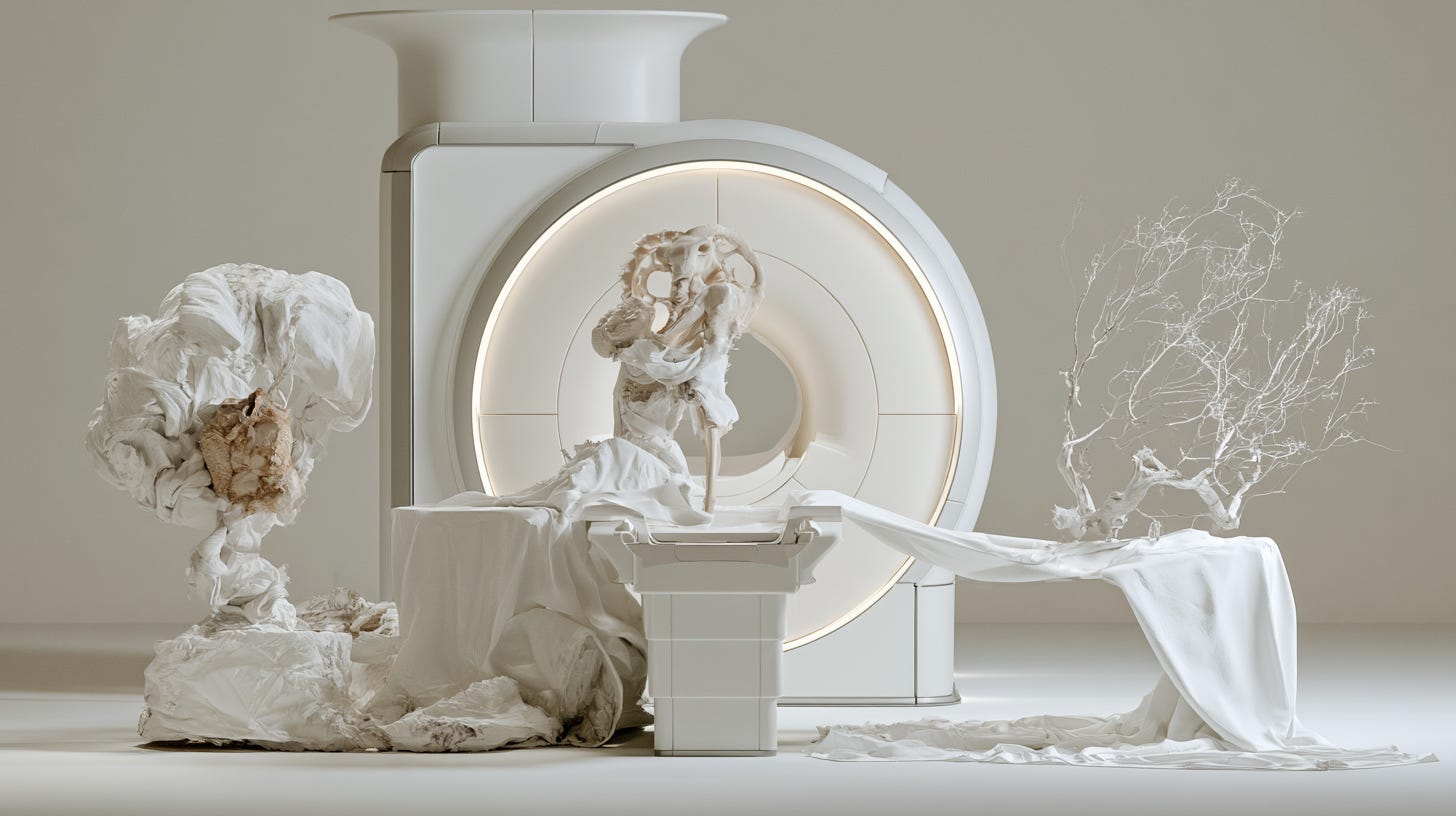
If you’ve ever had an MRI, you know how uncomfortable it is. I’m not talking about the generalized anxiety of a diagnosis; I mean the unpleasant multisensory experience your body and mind go through. You’re about to enter a narrow tube, and all they offer you is earplugs and, if you ask, medication for the anxiety. They might suggest you keep your eyes closed, so you won’t know, see, or remember that you’re in a tube. If you can’t take it anymore, you can press a button and they’ll let you out. But if you press it, how will they get your scans? After all, you’re there for a reason. So you stay. Unless claustrophobia becomes truly unbearable. Either way, you’ll walk away with a memory your mind will reluctantly revisit.
“[...] we feel an obligation as people standing on the frontier to look at the foundations of the human experience and ask: ‘What do we want to be different?’ ‘How do we want to be different?’ and ‘What do we want to become?’
We must ask these questions. We must find new answers. And we must tell stories of deeply human futures that we can all want to be a part of.” — Midjourney, “A New Era of Midjourney”
In June, Midjourney announced a new division, Midjourney Medical, that would focus on a new form of medical imaging: a full-body ultrasound. No radiation or magnetic field is involved, only sound and water. You stand on a platform and descend into water at five centimeters per second. Your body passes through a ring of roughly half a million ultrasonic elements, each sending sound waves through you and listening for what returns. Midjourney compares them to dolphins that use echolocation to map their surroundings. The whole process should take no more than sixty seconds. That, at least, is the target. A scan produces terabytes of data per second, which a cluster of thousands of computers reconstructs into a 3D map of your body resembling an MRI.
The first ten of these scanners will be inside the “Midjourney Spa,” opening in San Francisco at the end of 2027. Midjourney suggests that, with enough early imaging, the world could avoid thirty percent of all deaths and half of all healthcare costs. For now, none of it is diagnostic: the first scans will offer body-composition maps, and anything more will wait on the test results Midjourney says it will submit to the FDA.
Studies have found that up to a third of patients feel moderate anxiety inside an MRI machine1, and around the world an estimated two million scans a year cannot be completed because of it2. Researchers who followed patients for seven months found that a bad experience in the scanner left a third of those patients more claustrophobic than before3.
That’s why, when Midjourney announced a machine that would rival today’s MRIs, I wondered: how would it feel to have a full-body scan in a cozy room, your body immersed in a pool of water with golden light?
“It should be a place you love going, whether it's by yourself, or with friends. It should be available 24/7. The scans are a side-effect. You barely think of them when going to the spa. But suddenly, you have a huge library of data about your health.” — Midjourney, “A New Era of Midjourney”
Earlier this year I took a course on neuroarchitecture. I learned that certain environments are salutogenic, meaning they’re built to actively support human health and wellbeing. I learned that light, proportion, openness, the presence of nature, all of it acts on our nervous system before we can process it. Today, when I picture the room where I had my MRI in San Francisco, I remember how miserable it was. The machine was inside a trailer, parked within walking distance of a side entrance of the hospital. That day it was raining, and I didn’t have an umbrella. I sprinted to a mobile platform that would lift me “inside.” The trailer held the control room and the scanner room. The technologist, who was looking at screens, invited me to get undressed for the exam, pointing me to his right. There was a tiny corner at the end of the row of screens, with a curtain that I could pull. Once ready, he directed me to the “room” with the MRI machine, separated by a sliding door. My visual memory has many gaps, but I remember what it looked like from what I felt: a cluttered shelf on the side, the MRI machine in the center like an altar. White, cold, sad. I wasn’t surprised, except by the trailer; in my experience, this was the standard of care.
Now that I think about it: does it have to be so sad? People enter these rooms, ultimately, to be cured, to go on living. Yet they were designed as if healing were a punishment to be endured. In 1984, Roger Ulrich published a study that became the founding document of evidence-based hospital design: surgical patients whose window faced a stand of trees recovered faster and requested less pain medication than matched patients facing a brick wall4. The view outside the window was part of the treatment.
A scanner room has real constraints: nothing ferromagnetic can enter it, ordinary electronics interfere with the scan, and the radiofrequency shielding rules out a window. But there are hospitals that have been softening the scanner room from inside its constraints. They installed ambient systems, such as projected video, dynamic lighting, and murals. And these hospitals saw sedation rates collapse. At Singapore General Hospital, thirty patients who had already abandoned an MRI once and been booked for sedation were sent instead to a scanner with an ambient audiovisual system; twenty-eight of them completed the exam awake5. A Danish children’s hospital brought anesthesia in children aged four to six from fifty-seven to five percent with a themed room and a toy scanner to practice on6.
To me, the real wager of Midjourney Medical is leaving the constraints behind: no magnet, no shielding, no room to decorate. Sound instead of magnetism, water instead of a nice view.
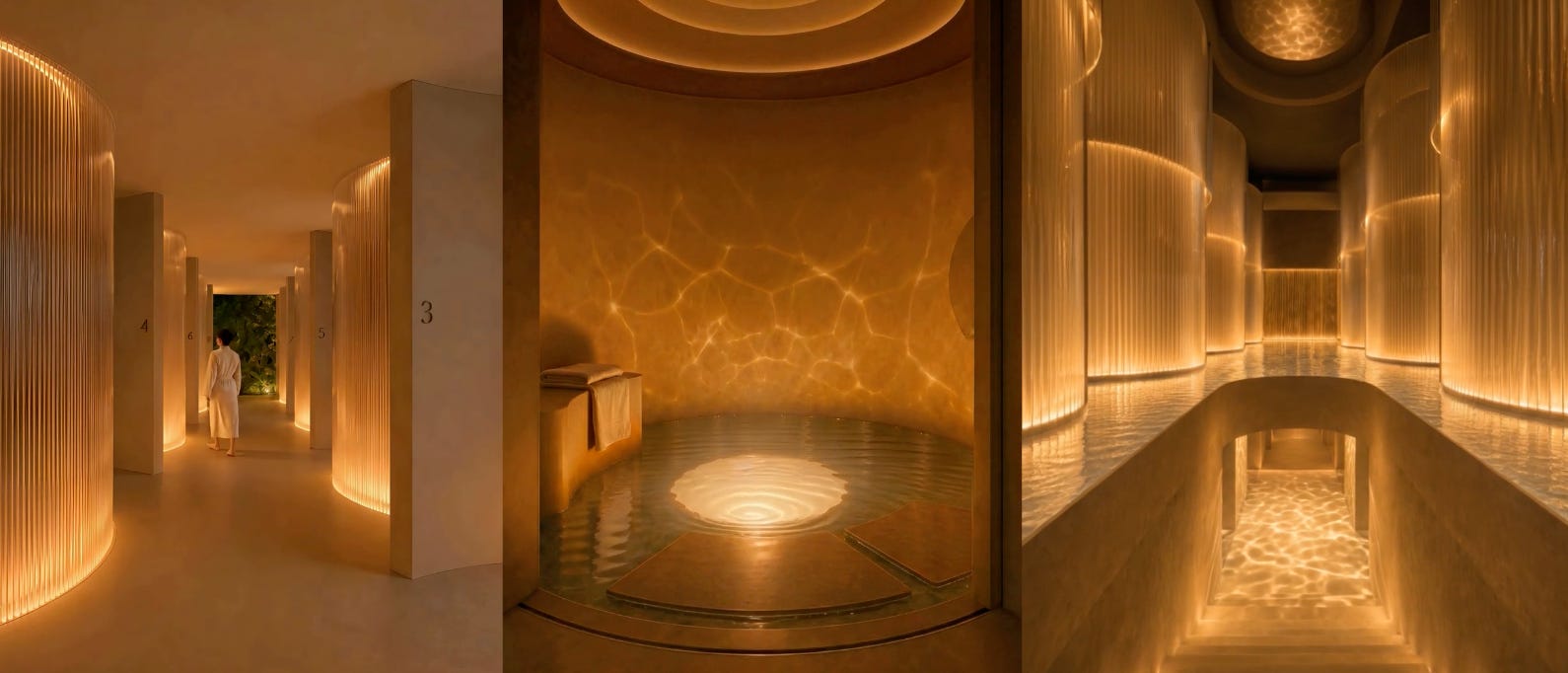
How would it feel to have a full-body scan in the Midjourney Spa? I assume it’d be pleasant. The most humane vision of medical imaging I’ve seen comes from what is reportedly the highest-grossing standalone AI image generator, with no clinical evidence and a very good render. And making pictures persuasive is the one thing Midjourney has proven it can do.
Katz, R. C., Wilson, L., & Frazer, N. (1994). Anxiety and its determinants in patients undergoing magnetic resonance imaging. Journal of Behavior Therapy and Experimental Psychiatry, 25(2), 131–134.
Munn, Z., Moola, S., Lisy, K., Riitano, D., & Murphy, F. (2015). Claustrophobia in magnetic resonance imaging: A systematic review and meta-analysis. Radiography, 21(2), e59–e63.
Enders, J., Zimmermann, E., Rief, M., et al. (2011). Reduction of claustrophobia with short-bore versus open magnetic resonance imaging: A randomized controlled trial. PLoS ONE, 6(8), e23494.
Ulrich, R. S. (1984). View through a window may influence recovery from surgery. Science, 224(4647), 420–421.
Yan, T., Ooi, C. C., Qiu, D., Wong, J., Chang, C., & Kheok, S. W. (2025). Using ambient audiovisual experiences to reduce the need for sedation in claustrophobic MRI patients. Radiography, 31(3), 102910.
Runge, S. B., Christensen, N. L., Jensen, K., & Jensen, I. E. (2018). Children centered care: Minimizing the need for anesthesia with a multi-faceted concept for MRI in children aged 4–6. European Journal of Radiology, 107, 183–187.