
I’ve been working on a new composition. A couple of months ago, a friend suggested how interesting it would be to see some of my original thoughts in my native language reflected in my art. It’s something that has stuck with me ever since. I had already been thinking about ways to integrate Italian into one of my works, and this felt like the right time to do it.
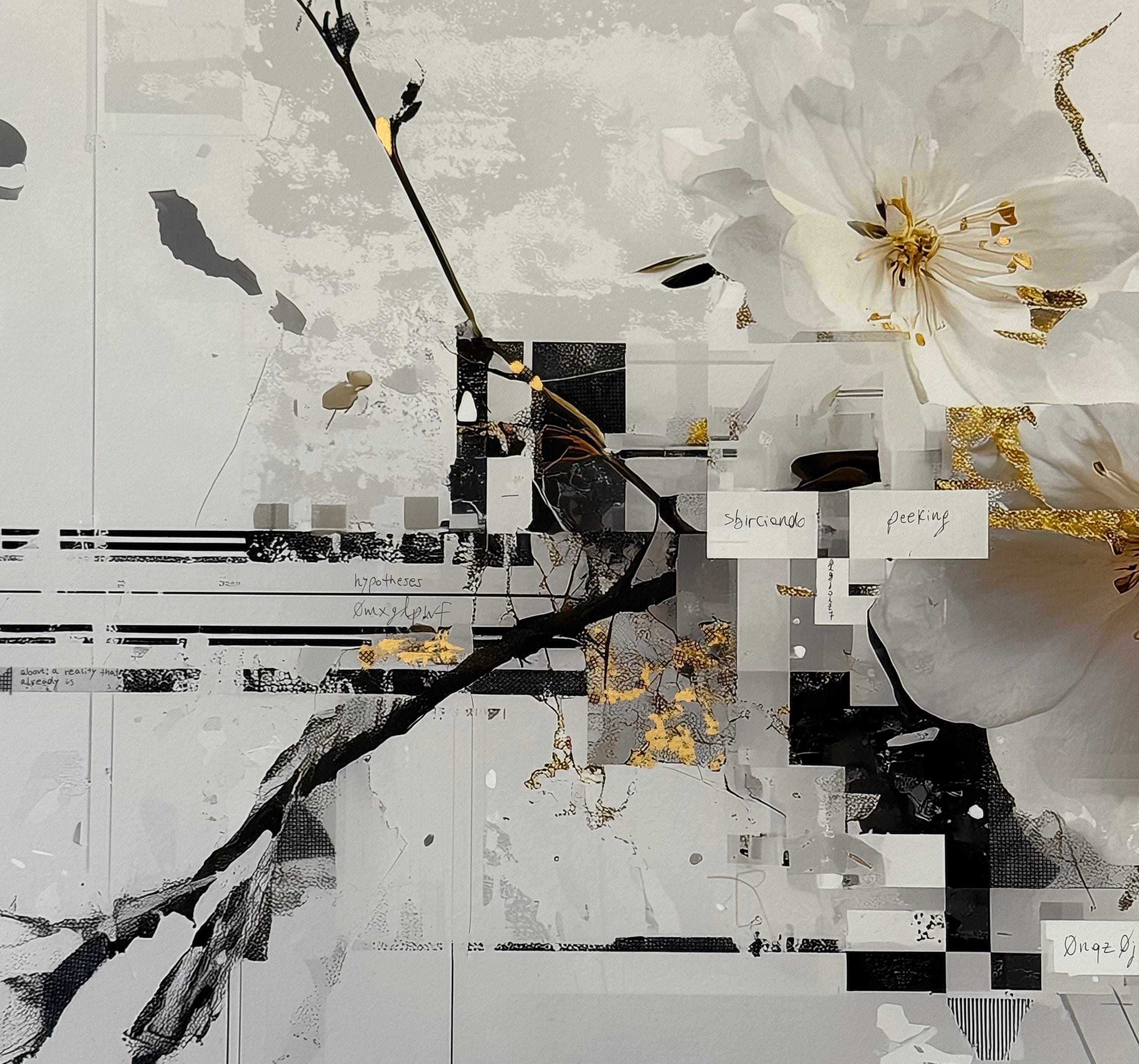
This new piece, nonduality, is part of my collection liminality where I explore in-between states from different angles. Think about an airport during a layover, between departure and arrival. Think of the feeling after an ending, when something is over, but what’s next hasn’t begun just yet. Liminal states are like that. It’s being jet-lagged, in between time zones, when you’re awake but not fully present. It’s exiting a game and returning to real life, after hours of being immersed in virtual reality.
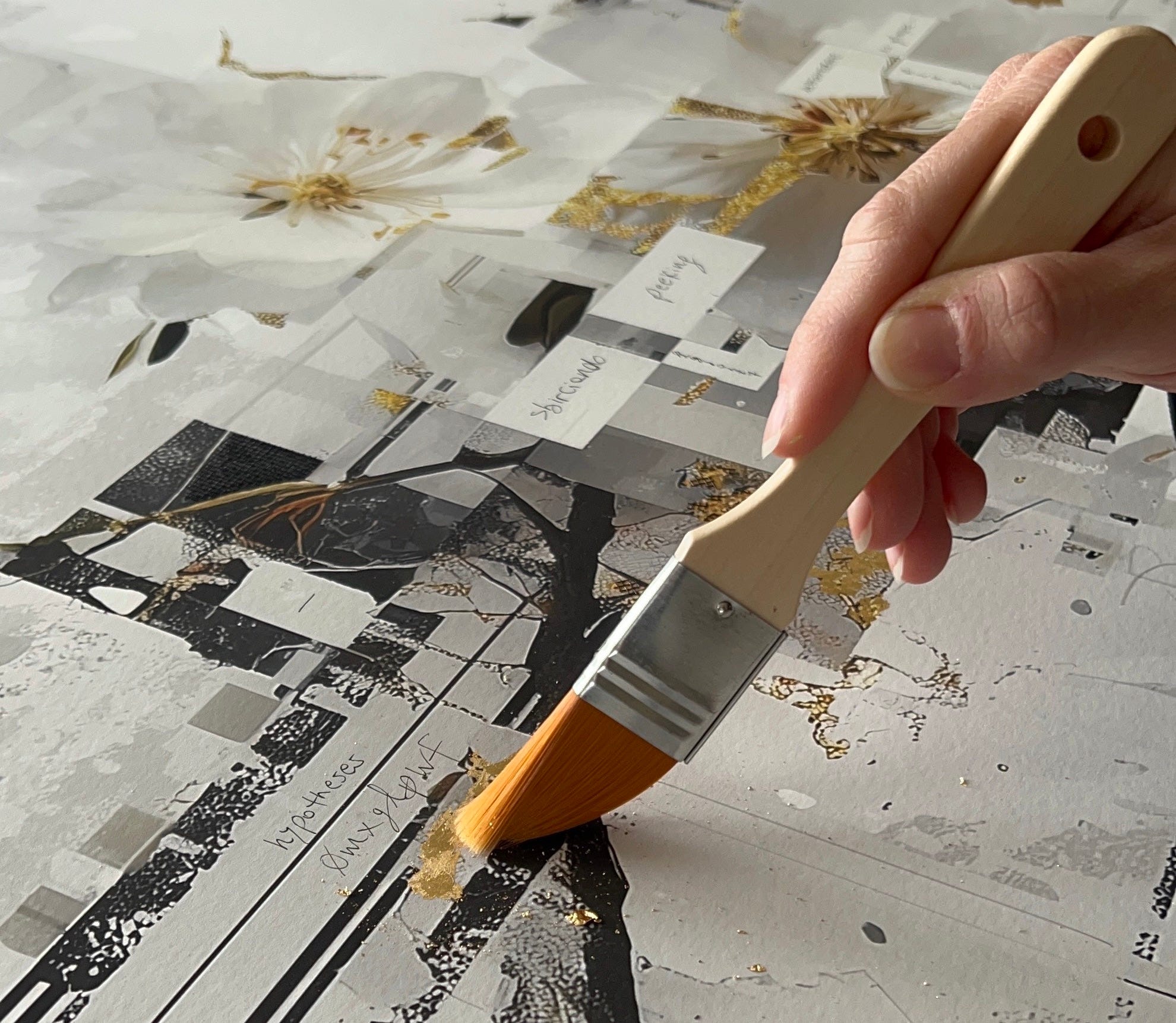
As I was reviewing my portfolio, I found myself re-examining what truly defines my work. And I realized that what I do is a form of computational art.
Computational art uses mathematical processes to make art, mapping numerical inputs to outputs in a systematic way. Algorithms, too, are a form of computation when executed digitally.
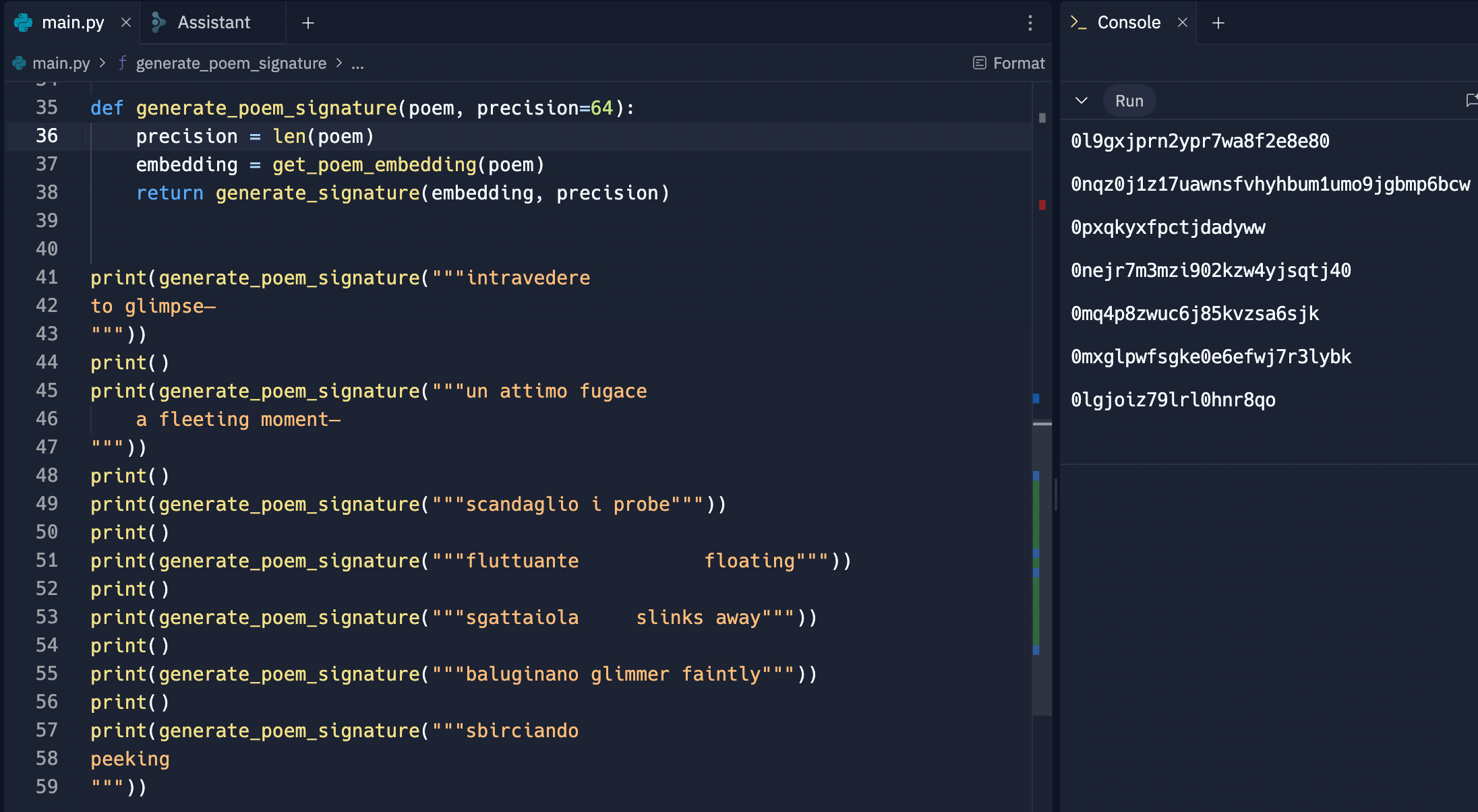
I use algorithms to generate images and translate meaning across different states. I take my poems and process them through embedding models, which are neural networks that convert words into numerical coordinates in a high-dimensional space based on their meaning.
Think of the semantic space as an invisible map of language where words with similar meanings, instead of being arranged alphabetically, are organized by context and relationships. For example, in this space the words ocean and sea would be close to each other because they share similar meanings. Ocean would be far from car, and close to both water and depth. Each word or sequence of words is assigned a set of coordinates. But instead of two dimensions (like X and Y), this space has hundreds or thousands of dimensions, capturing multiple layers of nuance with greater specificity.
In my work, I extract these high-dimensional representations of my poems and distill them into alphanumeric signatures, preserving a mathematical essence of each. They then become part of tangible artworks, where I incorporate them alongside physical materials like gold leaf.
I read every reply.
V.
a book
Notes on Complexity: A Scientific Theory of Connection, Consciousness, and Being by Neil Theise
It expanded how I think about boundaries. Meaning emerges through interactions. What seem like separate parts are, from another perspective, expressions of the same underlying whole.