
“I enter a building, see a room, and – in the fraction of a second – have this feeling about it. We perceive atmosphere through our emotional sensibility – a form of perception that works incredibly quickly.” — Peter Zumthor, Atmospheres (2006)
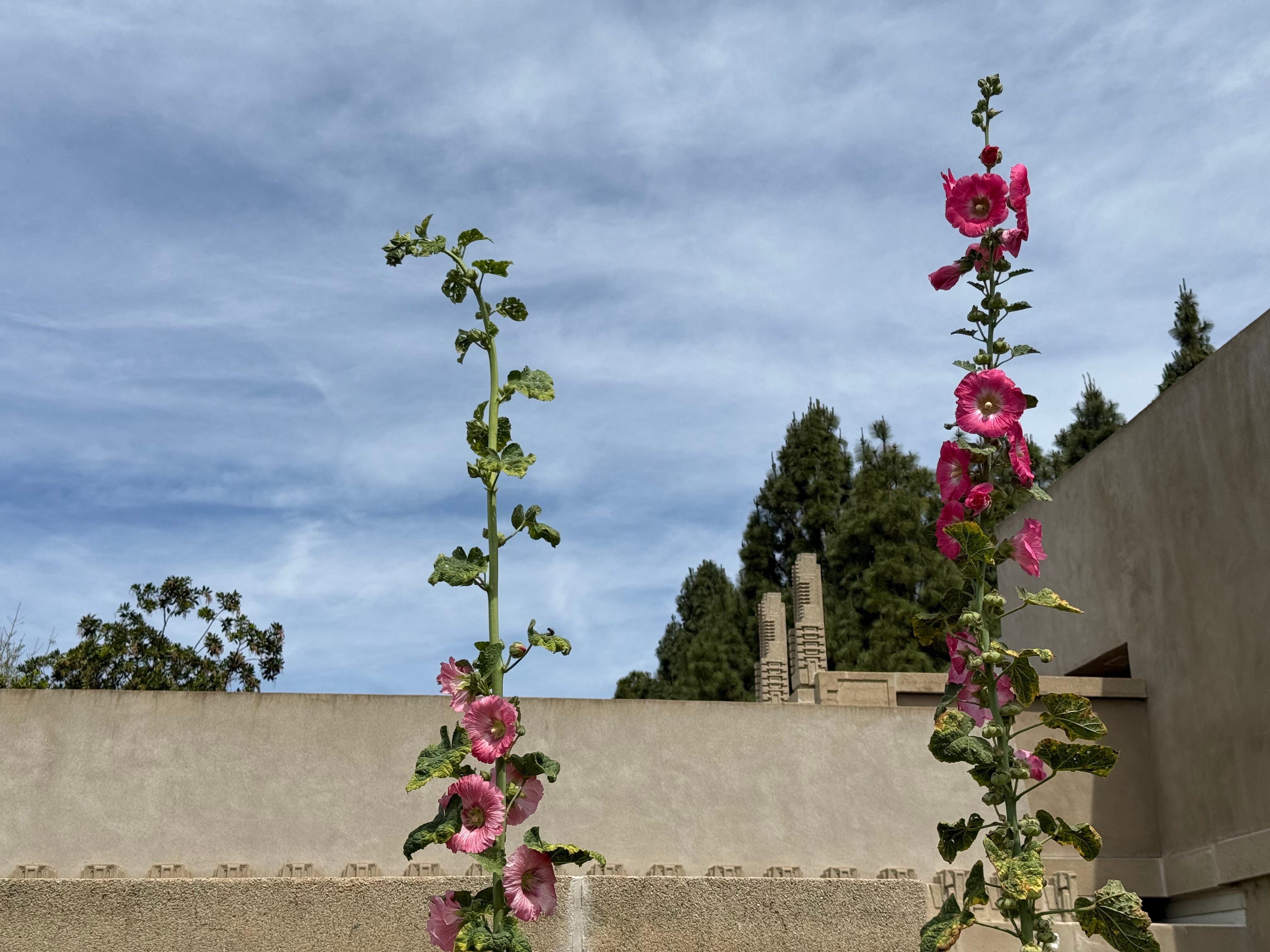
Last weekend, I visited Hollyhock House on a hilltop in East Hollywood, in Los Angeles. It felt like walking into an open temple. The interior was barely lit from within; the light arrived from the outside, through terraces and wide windows that in turn pulled my gaze toward green. The sightlines were completely uncluttered. I felt indoors and outdoors at the same time.
There were hollyhocks on one of the terraces. I learned that this flower was the favorite of the client, and that the architect, Frank Lloyd Wright, had abstracted it into a geometric form resembling vertebrae. He brought the motif into the carved stone, the furniture, the window glass, the textiles. He chose one flower as the recurring structure of the whole house.
I could feel my body responding to the house with stillness, serenity, restfulness. I understood that my response had been designed. Wright knew what the body needed, and built for it.
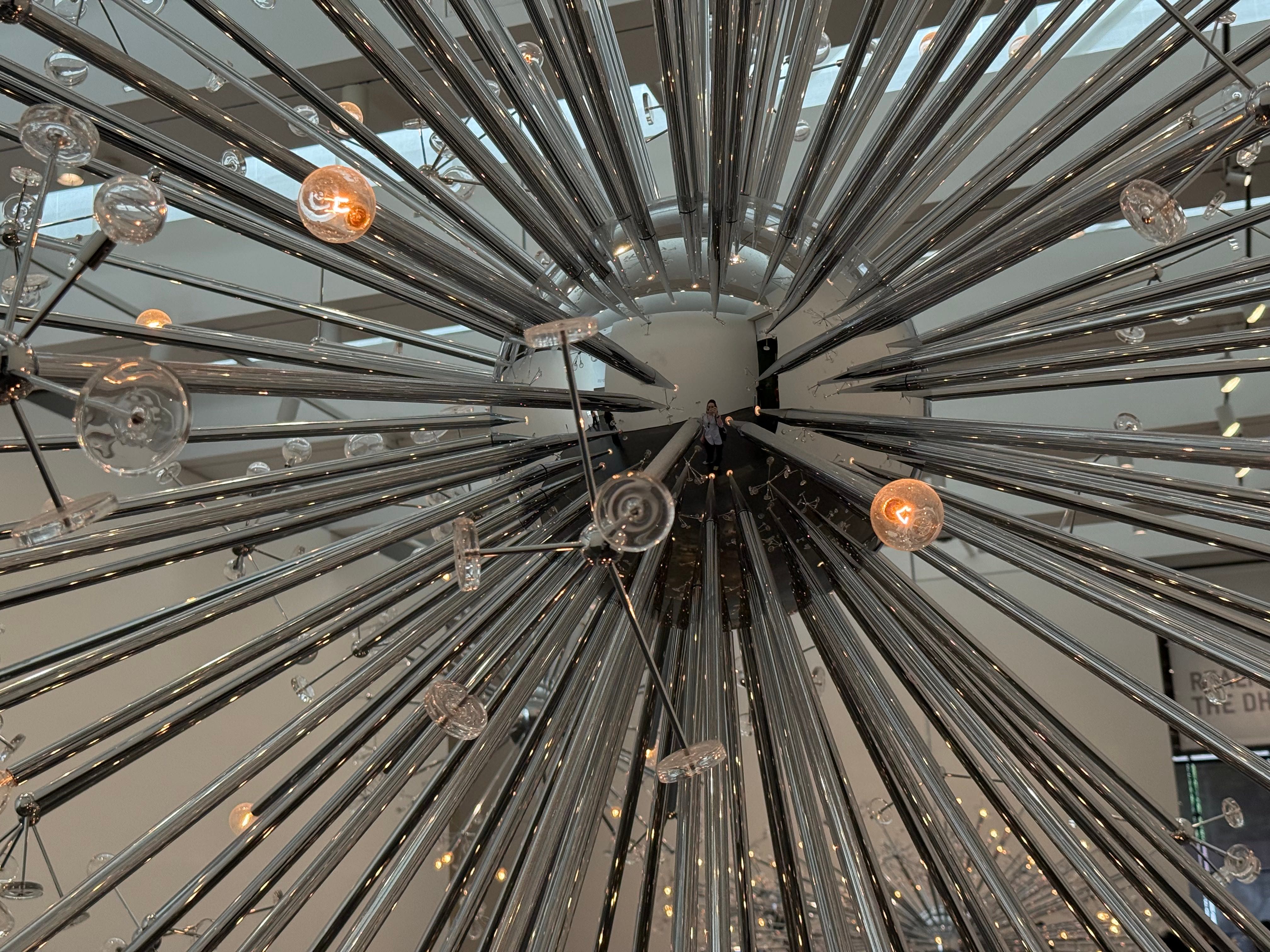
Later that day, I walked into a spacious pavilion at LACMA. Five enormous sculptures by Josiah McElheny were suspended across it. The installation, Island Universe, had been developed with the astrophysicist David Weinberg as a physical rendering of the multiverse. As a whole, it represented multiple universes coexisting, each expanding from its own origin. Chromed metal and glass rods acted like constellations branching outward from mirrored centers.
A friend said to me: Go to the center of the room. You’ll see yourself in all five at once.
From the center, I saw myself five times from five different perspectives. I felt both singular and dispersed. My body, standing at one point, came apart into five.
I’ve always thought of beauty as a kind of tension that pulls you toward it. Beauty was something I would just look at. I now try to let it act on me, then listen to what it stirs.
What I’d always called a “beautiful space” had little to do with an off-the-cuff judgment. “Beautiful” was not an accident but my body telling me how it felt. Wright designed a house to settle the body. McElheny’s universe scatters it.
a book
Piranesi by Susanna Clarke
Piranesi is a man living inside an infinite house of halls, staircases, and statues, where ocean tides move through the lower floors and clouds drift through the upper ones. He maps every room, knows the house meticulously, and treats it with reverence. It’s a story about what happens when the space you inhabit becomes indistinguishable from who you are, and what it costs to discover that other worlds exist beyond it.